
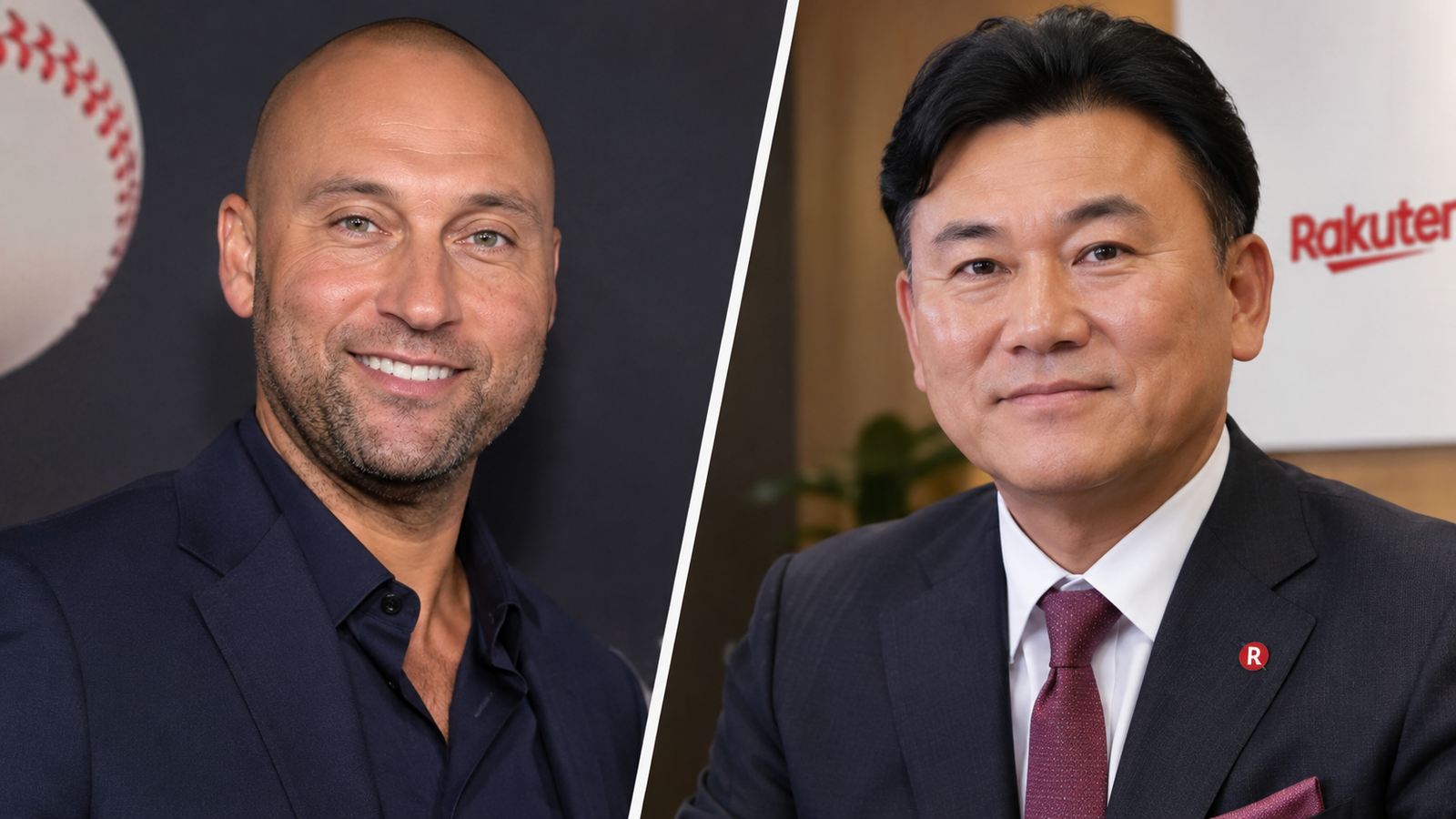
Derek Jeter and Hiroshi Mikitani: How Two Careers Connect Through Baseball
Derek Jeter and Hiroshi Mikitani are prominent figures from very different professional worlds, yet baseball creates a clear point of comparison between their careers. Jeter built his reputation as the longtime shortstop and captain of the New York Yankees before moving into baseball ownership and executive leadership. Mikitani built his career as the founder of Rakuten Group and later became directly involved in Japanese professional baseball through Rakuten Baseball and the Tohoku Rakuten Golden Eagles. Based on reliable public records, there is no well-established direct business partnership, family relationship, or joint venture between Derek Jeter and Hiroshi Mikitani. Instead, their connection is best understood through their separate roles in professional baseball, leadership, ownership, and the business side of sport. Official records provide extensive information about both men individually, while credible evidence of a close personal or commercial relationship between them is limited. This distinction matters because searches for both names together can create the impression that they worked as partners. The available evidence tells a more interesting and accurate story: two influential careers that reached baseball from opposite directions.
| Detail | Derek Jeter | Hiroshi Mikitani |
|---|---|---|
| Full Name | Derek Sanderson Jeter | Hiroshi Mikitani |
| Date of Birth | June 26, 1974 | March 11, 1965 |
| Known For | Former MLB player and New York Yankees captain | Founder and CEO of Rakuten Group |
| Main Field | Professional Baseball | Business and Entrepreneurship |
| Baseball Connection | New York Yankees; former Miami Marlins CEO and minority owner | Team owner of Rakuten Baseball |
| Major Achievement | Five-time World Series champion; Baseball Hall of Fame Class of 2020 | Founded Rakuten and helped establish its professional baseball operations |
| Education | Kalamazoo Central High School | Hitotsubashi University; MBA from Harvard Business School |
| Current/Recent Role | Businessman, investor, baseball media personality | Chairman, President and CEO of Rakuten Group |
Is There a Direct Relationship Between Derek Jeter and Hiroshi Mikitani?
The most important answer is simple: reliable public sources do not establish a significant direct partnership between Derek Jeter and Hiroshi Mikitani. There is no strong evidence in official MLB records, Rakuten corporate material, or the biographical sources reviewed for this article showing that they founded a company together, owned the same baseball organization, worked as formal business partners, or share a family connection. That does not mean they could never have met or appeared in the same wider sports or business circles. Public records simply do not support turning such possibilities into facts. Their meaningful connection is professional and thematic. Jeter moved from elite baseball player to team investor and executive. Mikitani moved from entrepreneurship and technology into professional sports ownership. Both therefore became involved in questions that go far beyond playing baseball: organizational culture, team development, business strategy, fan relationships, and the long-term value of sports organizations. For readers researching Derek Jeter and Hiroshi Mikitani, separating this documented overlap from an unsupported personal connection is essential.
Derek Jeter Built His Name on the Field
Jeter’s baseball identity came first. The Yankees drafted him in the first round in 1992, and he reached the major leagues in May 1995. His career then remained tied to one franchise for two decades. The National Baseball Hall of Fame lists him as the Yankees’ shortstop from 1995 through 2014 and highlights five championship teams during his career. MLB records show 3,465 career hits and a .310 batting average, numbers that place his playing career at the center of any serious account of his public reputation. He was also a 14-time All-Star and won five Gold Glove Awards, while his role as Yankees captain added a leadership dimension to his public image. His path matters to the Derek Jeter and Hiroshi Mikitani comparison because Jeter learned professional sports from inside the clubhouse before entering the boardroom. His later executive decisions came after thousands of games of direct experience with Major League Baseball’s competitive environment, media pressure, fan expectations, scouting systems, and player development. That is fundamentally different from entering sports first as an entrepreneur or corporate owner.
Jeter’s Move From Player to Baseball Executive
Retirement did not end Jeter’s involvement with professional baseball. In 2017, an ownership group led by Bruce Sherman and Jeter completed its purchase of the Miami Marlins. MLB announced that Sherman became chairman and principal owner while Jeter became chief executive officer. Jeter also held a minority ownership stake and took an active role in the organization’s operations. MLB later reported that he owned a 4% stake and oversaw day-to-day operations during his time with the club. This period changed the way Jeter could be evaluated. He was no longer responsible only for his own performance. He had to think about scouting, player development, front-office hiring, finances, long-term planning, and the direction of an entire franchise. Jeter had spoken about his interest in owning a Major League team before taking the Marlins role, and his move into management therefore represented a planned second chapter rather than an accidental career change. In the story of Derek Jeter and Hiroshi Mikitani, this is the stage where their careers become most comparable.
Why Jeter’s Miami Marlins Years Matter
Jeter’s tenure with Miami ran from 2017 until February 2022. The organization entered a major rebuilding period, with several established players traded as management tried to develop a stronger long-term talent base. MLB reported that the Marlins went 218-327 from 2018 through 2021, although they reached the postseason in the shortened 2020 season. The period also included significant front-office changes. In 2020, Jeter hired Kim Ng as general manager, making her the first female general manager of a major men’s professional sports team in North America. Jeter and the Marlins ultimately agreed to separate in February 2022, when he stepped down as CEO and shareholder. He said at the time that the vision for the franchise’s future differed from the one he had agreed to lead. This part of his career is useful when comparing Derek Jeter and Hiroshi Mikitani because it shows how difficult sports leadership can be once a famous name becomes responsible for organizational results.
Hiroshi Mikitani’s Path Began in Business
Mikitani reached professional sports from almost the opposite direction. His early career was in banking and entrepreneurship rather than athletics. Rakuten’s corporate profile says he joined the Industrial Bank of Japan in 1988 and earned an MBA from Harvard Business School in 1993. He founded Rakuten in 1997 and remained at the center of the company’s leadership as it expanded into a broad range of businesses. Rakuten says its ecosystem now covers more than 70 businesses across areas including e-commerce, digital content, communications, and fintech. Mikitani therefore entered sports with experience in corporate growth, digital services, finance, and brand building. His route provides a useful contrast to Jeter’s. Jeter developed leadership credibility through decades inside elite baseball and later entered business ownership. Mikitani developed his reputation in business and then brought corporate resources and entrepreneurial thinking into sport. This opposite movement is one of the strongest reasons Derek Jeter and Hiroshi Mikitani make an interesting comparison without needing an invented direct relationship.
How Hiroshi Mikitani Entered Professional Baseball
Rakuten’s move into Japanese professional baseball began in 2004. In September of that year, Rakuten announced that it had submitted an application for membership in Nippon Professional Baseball and planned to establish Rakuten Baseball, Inc. The company’s announcement named Hiroshi Mikitani as representative director. Rakuten’s corporate history states that Nippon Professional Baseball approved the Tohoku Rakuten Golden Eagles in November 2004. The company describes the club as the first new Japanese professional baseball franchise awarded in 50 years. Mikitani’s current Rakuten profile lists him as chairman, representative director and team owner of Rakuten Baseball, a position recorded from August 2012. Unlike Jeter, Mikitani did not move into ownership after a playing career. His involvement was tied to Rakuten’s expansion and the role sport could play within a much larger corporate ecosystem. This gives Derek Jeter and Hiroshi Mikitani two distinct models for entering the business of baseball.
The Tohoku Rakuten Golden Eagles and Rakuten’s Sports Strategy
The Golden Eagles became more than a side project within Rakuten’s history. Rakuten describes its 2004 entry into professional baseball as a major step in expanding the company’s presence and says the new team helped spread the Rakuten brand across Japan. The team is based in the Tohoku region and remains a central part of Rakuten’s sports activities. Rakuten’s current sports and entertainment materials present the Golden Eagles alongside other sports partnerships and describe sports as a way to connect communities across cultural and regional boundaries. The company’s involvement therefore combines competition, community identity, entertainment, and corporate branding. That broader context matters when looking at Derek Jeter and Hiroshi Mikitani. Jeter’s executive experience centered on operating an MLB franchise from inside its baseball structure. Mikitani’s ownership role sits within a diversified global company whose sports activities form part of a larger commercial and community strategy. Both involve baseball leadership, but the institutional settings are very different.
Two Different Routes From Reputation to Ownership
One useful way to understand Derek Jeter and Hiroshi Mikitani is to examine what each man brought into sports ownership. Jeter brought an established baseball identity. Players, fans, executives, and media organizations already knew him through his Yankees career. His challenge was converting the habits and credibility of a successful player into the very different work of organizational management. Mikitani brought an entrepreneurial identity. He had experience founding and expanding a major technology and services group before his involvement in professional baseball. His challenge was applying business resources, corporate strategy, and brand development to a sports organization with its own competitive culture. Neither route guarantees success. Playing expertise does not automatically make someone an effective owner or executive, while business success outside sports does not automatically solve player development or competitive problems. The comparison is useful precisely because it shows that professional sports sit at the meeting point of competition, finance, management, culture, and public trust.
Baseball Is the Strongest Link Between Their Stories
The shared theme connecting Derek Jeter and Hiroshi Mikitani is not a documented personal partnership but baseball’s evolution into a global business. Jeter represents Major League Baseball in the United States at both player and executive levels. Mikitani represents the ownership and corporate side of Nippon Professional Baseball in Japan. Their stories therefore show how one sport can create different forms of leadership across countries. Baseball teams need athletes and coaches, but modern organizations also depend on scouting networks, data, marketing, ticketing, media, sponsorships, community relationships, digital products, and long-term financial planning. A former superstar and a technology entrepreneur approach these demands from different starting points. Jeter’s background offers insight into the expectations inside a clubhouse and the pressures surrounding MLB performance. Mikitani’s background brings the perspective of an entrepreneur managing businesses across multiple sectors. Their careers illustrate how baseball can connect sporting expertise with broader business leadership even when the individuals are not formal partners.
Leadership Looks Different on the Field and in the Boardroom
Jeter’s transition also shows why leadership should not be treated as one universal skill. A shortstop can lead through preparation, consistency, communication, and performance. A CEO must make decisions that affect hundreds of employees and the future of an organization. Ownership adds financial responsibilities and long planning horizons. Mikitani’s experience highlights another version of leadership, where decisions about sports exist alongside corporate strategy and other businesses. Rakuten’s management information continues to identify him as chairman, president and CEO of the group in 2026. His official biography also documents leadership roles connected with Rakuten Baseball, Vissel Kobe, Rakuten Mobile, Rakuten Symphony, and Rakuten Medical. The comparison of Derek Jeter and Hiroshi Mikitani therefore works best when it avoids simplistic claims that one career mirrors the other. Their leadership environments, responsibilities, and routes to authority are distinct.
Jeter’s Career After the Marlins
Leaving the Marlins did not erase Jeter’s connection with baseball. His Turn 2 Foundation biography notes that he remained involved in business ventures and entrepreneurial investments after his playing career and that he joined MLB on FOX beginning with the 2023 season. His Hall of Fame status also keeps him closely connected to the history of the sport. The Baseball Hall of Fame identifies him as a member of its 2020 class, although the induction ceremony itself was postponed until 2021 because of the COVID-19 pandemic. This post-Marlins stage matters because Jeter should not be described only as a former player or former CEO. His public career has moved across playing, philanthropy, ownership, executive management, media, and investment. That range creates another point of comparison with Mikitani, whose career also extends well beyond a single role. Still, the scale and nature of their activities remain different, and the evidence does not justify presenting Derek Jeter and Hiroshi Mikitani as a formal business team.
Mikitani’s Role Extends Far Beyond Baseball
Mikitani’s sports involvement is only one part of a much broader corporate career. Rakuten’s current management page identifies him as the group’s Representative Director, Chairman, President and CEO. His official profile records roles involving Rakuten Baseball, Vissel Kobe, Rakuten Mobile, Rakuten Symphony, and Rakuten Medical, among other organizations. Rakuten itself operates across digital commerce, financial technology, communications, digital content, and other services. This context prevents a common misunderstanding. Mikitani is not primarily known as a baseball executive in the same sense that Jeter is primarily known for baseball. Professional sport forms one part of Mikitani’s wider business activities. Jeter’s public identity, by contrast, was built through baseball first and expanded into business later. That distinction gives the Derek Jeter and Hiroshi Mikitani topic more substance than a simple list of achievements because it shows how the same industry can attract leaders from completely different backgrounds.
What Their Careers Say About Sports as a Business
Modern professional teams must succeed in two connected areas. They must compete on the field while operating sustainable organizations away from it. The balance is difficult because decisions that help one side may create pressure on the other. Investing heavily in players can increase competitive ambition but also raise financial risk. Rebuilding a roster may improve long-term talent while frustrating fans who expect immediate success. Sponsorships and digital platforms can grow revenue, but a team still needs a credible sporting identity. Jeter experienced this tension directly in Miami, where management pursued a long-term rebuilding strategy while operating under intense public scrutiny. Mikitani’s involvement with the Golden Eagles shows another side of sports business: a professional team can also become part of a broader corporate and community ecosystem. Looking at Derek Jeter and Hiroshi Mikitani together helps explain why ownership is not simply about possessing a franchise. It involves balancing sporting goals, financial realities, employees, supporters, reputation, and long-term organizational direction.
Why Claims About a Partnership Need Care
Search results about public figures often combine names in ways that imply more than reliable evidence supports. This is especially risky when two people share an industry. A page may describe both men, repeat information from other websites, and gradually create the impression of a relationship that primary sources never documented. For Derek Jeter and Hiroshi Mikitani, the responsible approach is to start with official biographies, MLB records, Baseball Hall of Fame material, and Rakuten corporate information. Those sources clearly document Jeter’s Yankees career and Marlins leadership. They also document Mikitani’s Rakuten leadership and involvement with Rakuten Baseball. What they do not clearly document is a major joint venture between the two men. Absence of public documentation cannot prove that two public figures have never met, communicated, or shared a private connection. It does mean such details should not be stated as facts without evidence. This distinction protects readers from turning online association into biography.
What Makes the Comparison Useful
The value of comparing these careers comes from contrast rather than similarity alone. Jeter spent decades learning professional baseball from the player’s side before gaining ownership and executive responsibilities. Mikitani spent years developing businesses before using corporate leadership and investment to enter professional sports. Jeter’s baseball reputation preceded his business career. Mikitani’s business reputation preceded his baseball ownership role. One is closely tied to the history of the New York Yankees and Major League Baseball. The other is closely tied to Rakuten and the development of the Tohoku Rakuten Golden Eagles in Nippon Professional Baseball. Yet both careers eventually raised similar questions: How should a sports organization be built? How much should leaders focus on long-term development? How can a team maintain a relationship with its supporters? What does leadership look like when competitive and business goals meet? These are the real points of interest behind Derek Jeter and Hiroshi Mikitani.
Common Misunderstandings About Derek Jeter and Hiroshi Mikitani
Several misunderstandings can arise from seeing their names together. First, Mikitani was not Jeter’s owner during his Yankees career; Jeter played for the New York Yankees, while Mikitani’s documented baseball ownership is tied to Rakuten Baseball in Japan. Second, Jeter did not become an owner of the Golden Eagles. His documented ownership experience involved the Miami Marlins. Third, there is no strong public evidence that Mikitani and Jeter jointly purchased or operated a professional baseball club. Finally, comparing their careers does not mean their responsibilities were identical. Jeter was an MLB player before becoming a minority owner and CEO. Mikitani is a technology entrepreneur whose business group entered Japanese professional baseball and whose official profile lists him as Rakuten Baseball’s team owner. Keeping these facts separate produces a much clearer picture than assuming a direct relationship from a combined search phrase.
The International Baseball Context
Baseball provides the wider setting that makes this comparison meaningful. Jeter’s entire major-league playing career occurred with one of MLB’s most recognizable franchises. Mikitani’s company entered Japan’s professional baseball system by establishing a new club in the Tohoku region. Rakuten says the Golden Eagles became the first new professional Japanese baseball franchise awarded in 50 years. These stories sit in different leagues and business systems, yet both show how professional baseball creates powerful institutions around teams. A club represents more than its roster. It becomes part of a city’s or region’s identity, a workplace, a media product, a commercial brand, and a community organization. That wider view explains why the Derek Jeter and Hiroshi Mikitani comparison can interest readers even without a direct partnership. Their careers provide two windows into the same global sport: one through an iconic player’s transition into management and the other through an entrepreneur’s move into ownership.
FAQs
Are Derek Jeter and Hiroshi Mikitani business partners?
There is no strong, reliable public evidence establishing Derek Jeter and Hiroshi Mikitani as formal business partners. Their documented careers overlap mainly through professional baseball. Jeter became a minority owner and CEO of the Miami Marlins, while Mikitani is the founder and chief executive of Rakuten Group and is listed by Rakuten as team owner of Rakuten Baseball.
Did Derek Jeter ever play for a team owned by Hiroshi Mikitani?
No documented major-league part of Jeter’s career involved Mikitani’s baseball team. Jeter spent his entire MLB career with the New York Yankees from 1995 through 2014. Mikitani’s baseball ownership is associated with Rakuten Baseball and the Tohoku Rakuten Golden Eagles in Japan.
What baseball team is Hiroshi Mikitani associated with?
Mikitani is associated with the Tohoku Rakuten Golden Eagles through Rakuten Baseball. Rakuten’s official profile lists him as chairman, representative director and team owner of Rakuten Baseball. Rakuten entered Japanese professional baseball in 2004, and Nippon Professional Baseball approved the Golden Eagles that year.
What team did Derek Jeter own?
Jeter was part of the ownership group that purchased the Miami Marlins in 2017. He became the franchise’s CEO and held a minority stake. MLB later reported that Jeter owned 4% of the franchise before ending his role as CEO and shareholder in February 2022.
Did Derek Jeter and Hiroshi Mikitani work together in MLB?
Reliable public records reviewed for this article do not establish that they worked together in Major League Baseball. Jeter’s executive role was with the Miami Marlins. Mikitani’s documented team ownership is associated with Rakuten Baseball and Japanese professional baseball. Their connection is therefore best described as a shared involvement in the wider business of professional baseball.
Why are Derek Jeter and Hiroshi Mikitani compared?
They provide contrasting examples of how influential people can move into sports leadership. Jeter went from Hall of Fame player to MLB owner and executive. Mikitani went from banking and entrepreneurship to building Rakuten and entering Japanese professional sports. Their stories meet around baseball ownership and leadership rather than a clearly documented personal partnership.
Conclusion
Derek Jeter and Hiroshi Mikitani reached professional baseball from opposite directions. Jeter first became one of the defining Yankees players of his era, then moved into ownership and executive leadership with the Miami Marlins. Mikitani built Rakuten into a major business group before becoming deeply involved in professional sports, including Rakuten Baseball and the Tohoku Rakuten Golden Eagles. Official records clearly support those individual histories, but they do not establish a major direct partnership between the two men. That is the key point for anyone researching Derek Jeter and Hiroshi Mikitani. Their connection should not be exaggerated into an unsupported relationship. The stronger story is how a Hall of Fame player and a global entrepreneur each crossed the line between sports and business, showing two very different routes into the leadership of professional baseball.