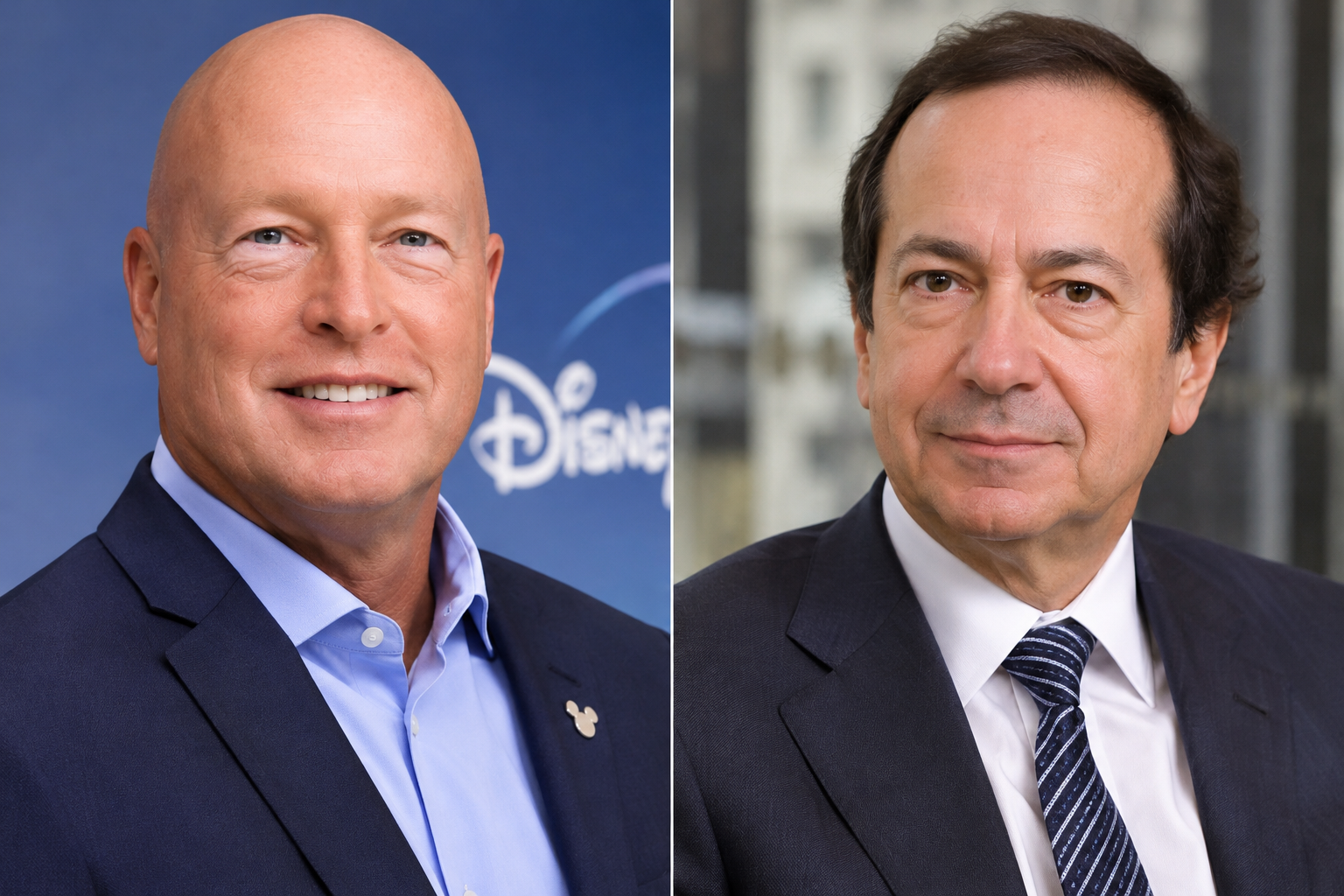
Bob Chapek and John Paulson: Is There a Real Business Connection?
Bob Chapek and John Paulson are prominent American business figures, but their careers developed in very different industries. Chapek spent nearly three decades at The Walt Disney Company and served as its chief executive from February 2020 until November 2022. Paulson built his reputation in investment management, founding Paulson & Co. in 1994 and becoming especially famous for positions against the U.S. subprime mortgage market before the financial crisis. Research into Bob Chapek and John Paulson does not establish a significant direct business partnership, shared company, family relationship, or joint venture between them. Their names make more sense as a comparison between two forms of business leadership. Chapek spent most of his career operating businesses inside a large public entertainment company. Paulson built his career deciding where capital should be invested and identifying opportunities that financial markets might have mispriced. Reliable sources document both careers extensively, but they do not establish the hidden partnership that a paired-name search might suggest.
Quick Bio
| Detail | Bob Chapek | John Paulson |
|---|---|---|
| Full Name | Robert Chapek | John A. Paulson |
| Nationality | American | American |
| Profession | Business and media executive | Investor and investment manager |
| Best Known For | Former CEO of The Walt Disney Company | Founder of Paulson & Co. and his subprime mortgage trade |
| Major Organization | The Walt Disney Company | Paulson & Co. |
| Education | B.S. in Microbiology, Indiana University Bloomington; MBA, Michigan State University | B.S., New York University; MBA, Harvard Business School |
| Major Leadership Period | Disney CEO, February 2020–November 2022 | Founded Paulson & Co. in 1994 |
| Primary Field | Entertainment, consumer products and theme parks | Investment management and finance |
| Famous Career Challenge | Leading Disney through the COVID-19 disruption | Making and managing large investment positions through changing markets |
| Documented Relationship | No significant direct relationship established in reliable sources reviewed | No significant direct relationship established in reliable sources reviewed |
Who Is Bob Chapek?

Bob Chapek is an American business executive best known for becoming the seventh CEO of The Walt Disney Company. His rise to the top was the result of a long internal career rather than an outside appointment. Disney says Chapek joined the company in 1993 after earlier work in brand management at H.J. Heinz and advertising at J. Walter Thompson. He held leadership positions across home entertainment, studio distribution, consumer products, theme parks, and experiences. Disney appointed him chairman of Walt Disney Parks and Resorts in 2015, and he later became chairman of Disney Parks, Experiences and Products. On February 25, 2020, Disney announced that Chapek would succeed Bob Iger as CEO. The timing was extraordinary. Only weeks later, COVID-19 forced major disruptions across Disney’s businesses, including theme parks and content production. Chapek remained CEO until November 20, 2022, when Disney announced that Iger would return to the position. The documented career behind Bob Chapek and John Paulson therefore places Chapek firmly in corporate operations, consumer businesses, media distribution, and entertainment management.
Who Is John Paulson?

John Paulson is an American investor and the founder of Paulson & Co. His career is rooted in finance rather than entertainment management. NYU Stern identifies him as a 1978 graduate and describes his professional path through investment banking and risk arbitrage before he created Paulson & Co. in 1994. Before starting his firm, Paulson worked at organizations including Bear Stearns and Gruss Partners. His name later became internationally known because of investment positions that benefited from the collapse of the U.S. subprime mortgage market. Reuters reported that Paulson personally earned about $4 billion from the celebrated 2007 trade. His firm later managed tens of billions of dollars at its peak. In 2020, Paulson announced that Paulson & Co. would return outside investor capital and convert into a private investment office, often described as a family office. That move changed the structure of his investment business but did not erase his importance in modern hedge-fund history. The professional record surrounding Bob Chapek and John Paulson therefore starts with two fundamentally different career models: a corporate operator and an investment manager.
Is There a Direct Bob Chapek and John Paulson Connection?
Reliable public sources reviewed for this article do not establish a significant direct relationship between the two men. There is no dependable evidence showing that they co-founded a company, served together on a major board, formed a joint venture, or operated as long-term business partners. There is also no established family relationship. This conclusion needs careful wording because the absence of a documented relationship cannot prove that two prominent businesspeople have never met, attended the same event, or had indirect contact. The important distinction is between possibility and documented history. A meaningful professional relationship would normally leave evidence in corporate announcements, regulatory filings, company biographies, interviews, or reputable financial reporting. Research into Bob Chapek and John Paulson does not produce that kind of evidence. Their careers are better understood separately unless a reliable source establishes a specific transaction or relationship.
Did John Paulson Invest in Disney While Chapek Was CEO?
An investment in a public company should not be assumed simply because a famous investor and a corporate CEO appear together in search results. Institutional investment positions can change from quarter to quarter, and even a disclosed shareholding would not automatically establish a personal relationship with the company’s chief executive. Public companies can have thousands of institutional and individual shareholders who never meet senior management. Research for this article did not establish a notable Paulson investment in Disney that created a direct relationship with Chapek. This is an important distinction for Bob Chapek and John Paulson because investment ownership and business partnership are different concepts. If evidence of a particular historical position is needed, the appropriate approach is to examine Paulson & Co.’s regulatory filings for the relevant quarter and security rather than infer ownership from general financial reporting. Even then, holding Disney shares would establish an investment position, not necessarily a personal or professional relationship with Chapek.
Chapek Spent Nearly Three Decades Inside Disney
Chapek’s career is useful because it shows how broad operating experience can lead to the top of a complex corporation. He joined Disney in 1993 and moved through businesses that faced major technological and consumer changes. In home entertainment, Disney credits him with helping the business transition through changing physical formats, including the move from DVD toward Blu-ray. He later served as president of Distribution for Walt Disney Studios, where his responsibilities included distribution across theatrical, home entertainment, television, digital, and emerging platforms. He then led Disney Consumer Products before taking control of the parks organization. His parks period included major expansion projects and the opening of Shanghai Disney Resort, as well as development connected with Star Wars and Marvel attractions. By the time he became CEO, he had experience with products, intellectual property, distribution, tourism, retail, and physical entertainment destinations. Bob Chapek and John Paulson therefore represent contrasting ways of building business expertise: Chapek developed deep operating knowledge inside one giant organization, while Paulson developed expertise by evaluating investments across companies and markets.
Becoming Disney CEO Just Before the Pandemic Changed Chapek’s Tenure
Chapek became CEO on February 25, 2020, and the pandemic quickly created a crisis that no normal succession plan could have fully anticipated. Disney’s theme parks depend on large numbers of people traveling and gathering in physical locations. Film production and theatrical distribution were also disrupted. Chapek therefore entered the CEO position while several of Disney’s traditional businesses faced severe operational uncertainty. At the same time, streaming became increasingly important to the company’s relationship with audiences. Disney later said Chapek led the company through the pandemic and recovery while expanding its streaming reach and changing parts of its parks business. In June 2022, Disney’s board unanimously voted to extend his CEO contract for three years. Only months later, however, the company changed direction and announced Iger’s return. This rapid reversal became one of the defining features of Chapek’s executive story. It also separates Bob Chapek and John Paulson in terms of risk. Chapek had to make operating decisions inside an organization facing a global disruption, while Paulson’s best-known career decisions involved allocating capital based on his interpretation of financial risk.
Why John Paulson’s Mortgage Trade Became Famous
Paulson’s most famous investment came from his view that parts of the U.S. housing and mortgage market had become dangerously overvalued. Rather than simply avoiding those assets, his funds took positions designed to benefit if mortgage-related securities deteriorated. The strategy became enormously profitable as problems in subprime lending intensified. Reuters later reported that Paulson earned roughly $4 billion from his 2007 subprime bet, while NYU Stern has described the episode as one of the most famous trades in financial history. The importance of the trade was not that Paulson predicted every detail of the global financial crisis. Its significance came from identifying a major imbalance, finding financial instruments that expressed his view, and maintaining the position despite a market environment in which that view initially looked unusual. That approach provides an interesting contrast within the Bob Chapek and John Paulson comparison. Paulson became famous for taking a contrarian market position. Chapek became famous by rising through an established corporate hierarchy and managing businesses at scale.
Paulson & Co. Eventually Became a Private Investment Office
Investment careers rarely move in a straight line. Paulson’s enormous success during the mortgage crisis did not mean every later investment generated similar results. Reuters reported that Paulson & Co.’s assets declined from their earlier peak and that performance became mixed in later years. In 2020, Paulson decided to stop managing outside client capital and convert the firm into a private investment office. The change allowed him to focus on investing his own wealth rather than operating a traditional hedge-fund structure for external clients. NYU Stern now describes Paulson & Co. as a private investment company specializing in areas including bankruptcy reorganizations, distressed opportunities, real estate, private equity, and event arbitrage. This later chapter matters because reducing Paulson’s entire career to one mortgage trade misses how long he had worked in risk arbitrage and event-driven investing. It also shows another difference between Bob Chapek and John Paulson: Chapek’s public reputation is tied strongly to positions he held inside Disney, while Paulson’s reputation centers on investment decisions made through a firm he founded.
Chapek’s Disney Exit Was a Major Leadership Reversal
Disney’s decision in November 2022 was striking because it came less than five months after the board had publicly extended Chapek’s contract. The company announced that Bob Iger would return as CEO effective immediately and that Chapek had stepped down. Disney thanked Chapek for his service and specifically acknowledged his leadership through the pandemic. The announcement did not provide a long public list of individual failures. Instead, the board said Disney was entering an increasingly complex period of industry transformation and concluded that Iger was best positioned to lead it. That distinction matters when discussing Chapek’s departure. It is easy to reduce executive changes to a single event, but large-company leadership decisions often reflect a combination of financial performance, strategy, board confidence, organizational culture, market expectations, and succession dynamics. For readers studying Bob Chapek and John Paulson, Chapek’s exit is a reminder that a senior executive can receive strong board support and still face a rapid change when directors reassess what leadership the company needs.
Both Careers Involve Risk, but the Risks Are Different
Risk provides one of the strongest legitimate comparisons between the two men. Paulson’s profession required him to evaluate securities, economic conditions, corporate events, and the probability that markets had priced assets incorrectly. His famous mortgage position involved direct investment risk. Chapek faced managerial risk. A CEO must allocate company resources, choose priorities, respond to competitors, manage employees, communicate with investors, protect brands, and make decisions whose results may take years to become clear. During the pandemic, Chapek also faced operational risks that extended far beyond normal business cycles. Comparing Bob Chapek and John Paulson through risk is useful only if those differences remain clear. A hedge-fund manager can change portfolio positions as new information appears. A chief executive managing theme parks, studios, streaming platforms, and thousands of employees cannot reposition a corporation with the speed of a securities portfolio. The word “risk” applies to both careers, but the mechanisms and consequences are different.
They Also Used Very Different Measures of Success
Investment management has relatively direct financial measures. Returns, losses, assets, risk, and capital preservation can be compared over defined periods. Corporate leadership is harder to reduce to one number. A Disney CEO must consider revenue, profit, cash flow, shareholder returns, subscriber growth, theme-park demand, film performance, brand strength, employee relations, creative output, and long-term investment. Some decisions that reduce short-term earnings can support long-term growth, while strong short-term results can hide future problems. This makes a simple Bob Chapek and John Paulson scorecard misleading. Paulson’s 2007 mortgage trade can be evaluated through the extraordinary financial gains it produced. Chapek’s Disney record involves multiple business segments operating through a pandemic and a rapidly changing media market. The careers can be compared, but they should not be judged through identical metrics.
Education Played an Important Role in Both Careers
Their educational backgrounds also show different routes into senior business roles. Disney’s official biography states that Chapek earned a bachelor’s degree in microbiology from Indiana University Bloomington and an MBA from Michigan State University. His undergraduate subject was not the obvious starting point for a future entertainment CEO, but his career moved into advertising, brand management, marketing, distribution, consumer products, and operations. Paulson’s path was more directly connected to finance. NYU Stern identifies him as a 1978 graduate, while Harvard records him as an MBA graduate from the class of 1980. NYU’s account of his career says his interest in risk arbitrage grew while studying business and listening to finance professionals discuss investment strategies. Bob Chapek and John Paulson therefore both added graduate business education to their backgrounds, but they applied that training in very different professional settings.
John Paulson Became a Major Philanthropic Donor
Paulson’s public legacy extends beyond investment management. In 2015, Harvard announced that he had given $400 million to support its School of Engineering and Applied Sciences. At the time, Harvard described it as the largest gift in the university’s history and renamed the school the Harvard John A. Paulson School of Engineering and Applied Sciences. Harvard also noted Paulson’s support for education, arts, health care, and conservation. NYU has likewise documented significant gifts from Paulson, including a $20 million contribution announced in 2009 to support faculty positions, scholarships, and facilities. These gifts add another dimension to his public biography that has little to do with Chapek’s Disney career. In the Bob Chapek and John Paulson comparison, philanthropy is therefore an important part of Paulson’s individual story rather than evidence of a relationship between the two men.
Bob Chapek’s Career After Disney
Chapek kept a relatively low public profile after leaving Disney, but he did return to a formal corporate role. In January 2024, medical technology company Masimo announced that he had joined its board of directors. Reuters reported that Masimo expected to benefit from Chapek’s experience as the company pursued its hospital-to-home strategy. The appointment showed that his expertise in consumer businesses, technology adoption, and large-scale management remained relevant outside entertainment. It also demonstrates why profiles that describe Chapek only as a former Disney CEO can become outdated. His post-Disney activities need to be checked by date rather than assumed. None of this creates a documented Bob Chapek and John Paulson partnership, however. It simply adds another stage to Chapek’s independent business career.
Their Leadership Models Are Almost Opposites
Chapek’s rise depended on operating within an established institution. He accumulated responsibility across divisions and eventually became CEO after decades inside Disney. That model rewards organizational knowledge, execution, internal relationships, and the ability to manage increasingly complex operations. Paulson took a more entrepreneurial route. He worked for other financial firms, developed expertise in mergers and risk arbitrage, and then created his own investment company in 1994. His professional authority came largely from capital allocation and investment performance rather than from climbing one corporate hierarchy. This contrast gives Bob Chapek and John Paulson genuine analytical value as a paired topic. One career shows how an executive can move upward inside a famous global corporation. The other shows how an investor can build a firm around independent judgment and market opportunities.
A Shareholder Is Not Automatically a CEO’s Business Partner
One misunderstanding deserves special attention because Paulson is an investor and Disney is publicly traded. If an investment manager owns shares in a company, that fact alone does not make the manager a partner of the CEO. Public-company ownership is dispersed across institutions, funds, retirement accounts, executives, and individual investors. Many shareholders never communicate directly with management. Even activist investors who do communicate with boards should not automatically be described as personal partners of company executives. For Bob Chapek and John Paulson, this means a hypothetical or historical Disney shareholding would need to be separated from claims about a personal relationship. Evidence of stock ownership proves ownership for the reported period; it does not prove friendship, collaboration, or a joint business venture.
There Is No Established Family Relationship
Reliable biographical information reviewed for this article does not identify the two men as relatives. Their professional histories also come from separate backgrounds and industries. Paired-name searches often lead readers to wonder about family ties because celebrities, executives, and wealthy individuals can appear together in automatically generated search suggestions. That association is not evidence of genealogy. Bob Chapek and John Paulson should not be described as family members without reliable documentation supporting such a claim. No such relationship was established in the authoritative and reputable sources reviewed here.
Search Results Can Create Connections That Do Not Exist
Search engines are designed to identify patterns in pages, queries, entities, and user behavior. They are not proof systems. Two people can appear together because websites compare business leaders, because users repeatedly search both names, or because automated systems associate them with broad subjects such as wealth, leadership, investing, or corporate America. Low-quality biography sites can then reinforce the association by publishing articles based on the search phrase itself. That cycle can make an unsupported relationship appear more established than it really is. The safest approach to Bob Chapek and John Paulson is to start with primary biographies, corporate records, university sources, regulatory documents, and reputable financial reporting. If those sources do not establish a partnership, a writer should not create one simply to make the keyword more interesting.
What Their Careers Can Actually Teach
The strongest value in comparing these men comes from their different approaches to uncertainty. Chapek’s career demonstrates the importance and difficulty of execution inside a complex organization. His Disney experience covered physical products, media distribution, theme parks, intellectual property, streaming, and global operations. His brief CEO tenure also demonstrates how quickly external conditions and board expectations can reshape executive leadership. Paulson’s career demonstrates a different lesson: independent analysis can produce extraordinary results when a market consensus is wrong, but past success does not eliminate future investment risk. His later conversion of Paulson & Co. into a private investment office also shows how a business model can change as priorities evolve. Bob Chapek and John Paulson therefore offer useful case studies without needing a hidden partnership. Their documented careers already provide enough material to examine leadership, risk, timing, capital, reputation, and adaptation.
What Reliable Sources Actually Establish
The evidence supports clear individual histories. Disney documents Chapek’s long career across studio distribution, consumer products, parks, and corporate leadership, as well as his appointment as CEO in February 2020. Disney also documents Iger’s return in November 2022 and Chapek’s departure. NYU and Harvard document Paulson’s education, investment career, founding of Paulson & Co., and philanthropy, while Reuters documents his famous subprime trade and the 2020 conversion of his firm into a private investment office. What those dependable sources do not establish is equally important: they do not show a significant shared company, joint venture, family relationship, or major professional partnership between Bob Chapek and John Paulson. That is the central answer readers should carry away from the paired search.
Frequently Asked Questions
Are Bob Chapek and John Paulson business partners?
No significant business partnership between them was established in the reliable public sources reviewed. Chapek built most of his career at Disney, while Paulson built an investment-management career through Paulson & Co.
Did John Paulson work for Disney?
Reliable biographies of Paulson describe a career in finance, investment banking, risk arbitrage, and investment management. They do not establish that he worked as a Disney executive or employee.
Did Bob Chapek work for Paulson & Co.?
No reliable career record reviewed shows Chapek working for Paulson & Co. Before and during his Disney career, his documented background included J. Walter Thompson, H.J. Heinz, and numerous Disney leadership positions.
What is John Paulson best known for?
Paulson is best known for founding Paulson & Co. and for investment positions against the U.S. subprime mortgage market that generated enormous gains as the housing and credit markets deteriorated.
Why did Bob Chapek leave Disney?
Disney announced in November 2022 that Bob Iger would return as CEO and that Chapek had stepped down. The board said Disney was entering an increasingly complex period of industry transformation and considered Iger best positioned to lead the company.
Are Bob Chapek and John Paulson related?
No documented family relationship between them was established in the reliable sources reviewed. Their paired appearance in search results should not be treated as evidence that they are relatives.
Conclusion
Bob Chapek and John Paulson are best understood as two separate American business figures whose careers offer an interesting contrast rather than a documented partnership. Chapek spent nearly three decades building operating experience inside Disney before serving as CEO during one of the most disruptive periods in the company’s history. Paulson built an investment firm, became famous for his contrarian position against the subprime mortgage market, and later converted his firm into a private investment office. Reliable sources do not establish that the two men co-founded a company, shared a major board role, formed a joint venture, or belong to the same family. The practical lesson is simple: a paired search term should start a research question, not settle it. In the case of Bob Chapek and John Paulson, the evidence supports a comparison of leadership, investing, risk, and decision-making, but not a hidden personal or business relationship.